
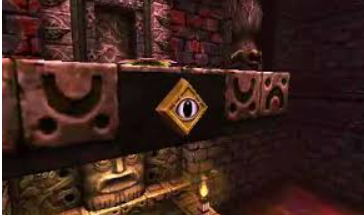
Ocarina of Time and Tears of the Kingdom, despite being from the same video game franchise, are polar opposites on a game-design front. Ocarina of Time focuses on restricted access to certain locations in an effort to follow a natural, linear progression. In contrast, Tears of the Kingdom gives players complete freedom to do whatever they want, whenever they want. These two game philosophies not only encourage completely different play-styles, but they also require their puzzles to be approached at a whole new angle when given almost limitless freedom or restricted abilities. Before we dive deeper into the disparities between the puzzles in these two games, we must first understand each game’s progression and what that style of progression aims to accomplish.
When you play Ocarina of Time, you will follow a structure that repeats throughout most of the game: explore a newly unlocked area, talk to the NPCs to progress the story, gain access to a dungeon, obtain an item, defeat a boss, and, finally, use that item to unlock a new area. Figuring out how to progress relies on assessing your limitations and using the items you currently have in your arsenal. This idea further extends to the game’s puzzle design: seeing as there is only a single solution, solving the problem relies on spatial awareness and logical thinking when deciding which item would be best. Think of the classic “light up all the torches” puzzle. Spatial awareness is used when you notice the unlit torches next to the lit one, and when you think, “a deku stick can light torches,” you are developing logical thinking. Like the progression, Ocarina of Time’s puzzles are very straightforward, requiring the identification of the solution and direct implementation of said solution.
On the contrary, Tears of the Kingdom plops you down in a gigantic sandbox with four main abilities (Recall, Fuse, Build, and Ascend) and tells you to find places to explore. There is no set path for you; you have to carve your own. Also, no longer are there limitations on what items you have at a given moment; you have access to everything from the start. As you may expect, this would also change how puzzles in this game are designed. Instead of one solution, there could be multiple ways of tackling a problem, going along with the philosophy of carving your own path. These types of puzzles focus more on creative thinking, since now you do not have to look for the solution that the game wants you to find. Thinking outside the box is key here, as the trial and error of new ideas will eventually lead you to a new discovery or solution. Everyone’s solutions will be different; one might choose to stack crates and boxes while another will rewind a falling block and use ascend to gain height. Much like sandbox progression, the puzzles are very open and allow for a lot of freedom for the player to solve how they wish.
Concerning the question of which is better comes down to personal preference for what you want to see in a puzzle. If you prefer straightforward, logical-reasoning focused puzzles, Ocarina of Time might be more up your alley. However, I enjoy discovering new ideas and thinking outside the box. I often am frustrated when I am denied access to a new area to explore. I prefer the freedom that an open-world game gives me, so I definitely prefer Tears of the Kingdom’s style of puzzles. Despite my opinion, though, these two games are very interesting to study in relation to one another because they both represent two very different designs for an adventure game, and from what I have talked about, I would consider them both to be truly legendary.