
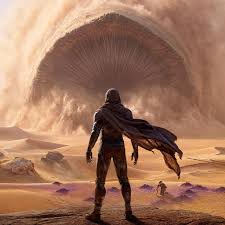
Frank Herbert’s novel Dune uses aspects of desert life on Arrakis, the Atreides family, the effects of melange on Paul and Jessica, and the significance of animals to symbolize the reality of living in harsh environments, the corruption of hunger for power, and the dangers of religious power and addiction.
Dune’s primary setting is the desert planet of Arrakis, a harsh environment where water is extremely important to the planet’s native inhabitants, the Fremen, due to its scarcity. Water primarily symbolizes survival and hope for a better future. It is often associated with life, as many organisms need water to survive, and it serves as a fundamental building block for almost all its forms. This is especially evident on Arrakis, where the Fremen’s survival depends on how much water they are able to gather, preserve, and protect daily, marking its importance to the Fremen’s beliefs and customs in relation to their environment, such as their reference to blood as the “body’s water,” which implies that the Fremen view water as the blood of their world. At one point, a member of the Fremen tells Thufir Hawat, “This is the bond of water. We know the rites. A man’s flesh is his own; the water belongs to the tribe” (191). This insight shows how the tribe came together through water, their key to survival. The purpose of water’s symbolism in the novel is to parallel the scarcity of important resources in many real-life situations around the world, from sufficient food and water to money, which people begin to obsess over due to its rarity and get as much as they can of it, just as the Fremen’s entire culture has been built around water due to its rarity. Water could also parallel the prophecy of the Kwisats Haderach, as just like water, the Fremen believe that they need Paul and much culture and religion is built around him.
However, water is not the only valuable resource in the novel. Melange, otherwise known as spice, is the most valuable trading resource in the universe, due to its effect on the user’s perception, giving them the ability to access genetic memories, as well as making it possible for navigators to travel safely. At one point, Baron Harkonnen says, “He who controls the spice controls the universe”, showing that spice has an immensely important role in this universe. Like water to the Fremen, melange is a rare substance. However, ironically, it can only be found on Arrakis. Because of its power and rarity, the Great Houses of the Imperium fight and kill for control over the spice, such as the Harkonnens and the Sardaukar, and the Fremen, native to Arrakis, are oppressed for control over the spice fields. The importance and production of spice in Arrakis is allegorical to fossil fuel wars in the Middle East, which Arrakis is greatly inspired by. Spice is also shown to be highly addictive despite its power and benefits, as shown when Paul and Jessica’s abilities of perception are enhanced by the use of spice, but they become addicted to it. In Chapter 22, Paul tells Jessica that spice is “a poison- so subtle, so insidious…so irreversible. It won’t even kill you unless you stop taking it. We can’t leave Arrakis unless we take part of Arrakis with us.” This shows that Paul and Jessica have become addicted to spice to the point where they can’t live without it. The time period that Dune was written in is also relevant–the novel was written in 1965, a time when hallucinogenic drugs had risen in popularity. Like spice, people took these drugs believing that they would give them enhanced perception and abilities, but they were addictive and dangerous to users.
Another important symbol tied to the Atreides is the bull’s head, which represents the Atreides legacy and approach to dangerous circumstances, such as receiving stewardship of Arrakis. The bull’s head, which accompanies a painting of Paul’s grandfather, still has the blood of when it killed the Old Duke, serving as a subtle reminder that there is danger for the Atreides family. The Old Duke, a man of high status and privilege, was killed in a battle with the bull, showing that not even the most powerful beings are invincible. The bull’s head also symbolizes a fatal flaw in the strength of the Atreides legacy and mindset. The battle between the Old Duke and the bull demonstrates the dangerous risks that Atreides, such as Paul or Duke Leto, are willing to take to achieve their goals, which allows Paul to defeat the Harkonnens and become the new Emperor and Duke Leto to immobilize the Baron in his final moments. On page 62, when Jessica looks at the bull head and the painting of Duke Leto’s father, her internal monologue is described: “The head and the painting. She knew there was something symbolic in the action. Not since the day when the Duke’s buyers had taken her from the school had she felt this frightened and unsure of herself.”
She dislikes looking at the bull head because it shows that trouble is near for them, and she dislikes looking at the painting because Duke Leto’s father fighting the bull symbolized how his chance with risks when people had depended on him ended up killing him.
Animal symbols are prevalent throughout the novel, one such being “muad’dib”, or the desert mouse. “Muad’Dib” is derived from the Arabic word “muaddib”, meaning “teacher”. On Page 388, when Paul chooses “Muad’Dib” as his Fremen name, Stilgar tells him, “Muad’Dib is wise in the ways of the desert. Muad’Dib creates his own water. Muad’Dib hides from the sun and travels in the cool night. Muad’Dib is fruitful and multiplies over the land. Muad’Dib we call an instructor of boys.” This shows that Muad’dib is viewed as a teacher of sorts to the Fremen, as it shows how to survive in the harsh environment of the desert. The name also takes on significance as Paul is a messiah figure to the Fremen, guiding them through the war. The sandworms are revered and worshiped by the Fremen as gods of Arrakis, and are referred to as “Shai-Hulud”. To the Fremen, they symbolize creation and protection, as they produce spice, the Water of Life, and transportation.
The sandworms represent divinity and acceptance of fate. The sandworms are known as “Shai-Hulud” to the Fremen, which is derived from the Arabic words “Shai”, meaning “thing”, and “khulud”, meaning immortality. When people see the sandworm rising out of the desert, they chant, “Bless the Maker and His Water, bless the coming and going of Him. May His passing cleanse the world. May He keep the world for His people” (124). Due to their ability to produce spice, their gargantuan size, and their provision of transportation and protection, they are viewed as gods of the desert, much like how Paul is revered as a messiah. Riding a sandworm is a rite of passage for young Fremen coming of age, and it marks the beginning of their transition into adulthood. This mirrors Paul becoming more confident in his role as the Messiah and accepting his destiny when he rides a sandworm for the first time.
The correlation between spice and the real world, the impact of water on Fremen culture and society, and the importance of the bull, the desert mouse, and the sandworms act as symbols of real-world fossil fuel wars and drug use, tie into the Atreides legacy of danger, and tie into Paul’s role as the Messiah.