
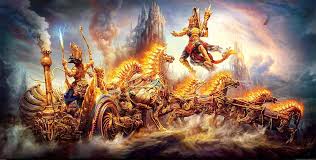
The Mahabharata is an ancient Indian epic, one of the longest pieces of literature in human history. Centuries after its composition, the Mahabharata’s length exceeds that of any other ancient text, consisting of over 1.8 million words, serving as a narrative framework for the stories that are told today. Its influence stretches beyond traditional Indian literature into modern global fiction that transcends cultural borders.
Composed between 400 B.C.E. and 200 C.E., the Mahabharata centers on the dynastic struggle between two groups of cousins—the Pandavas and the Kauravas—leading to a cataclysmic war. Unlike simple morality tales, the epic often highlights that the “good guys” (Pandavas) are flawed, while the “bad guys” (Kauravas) sometimes exhibit noble behavior, creating a “polychromatic morality”. It serves as a guide for dharma (duty), kama (desire), artha (prosperity), and moksha (liberation), making it a comprehensive exploration of the human condition.
A Mirror of Human Nature: Flaws and Virtues
The Mahabharata’s lasting impact on literary tropes lies in its realistic, deeply psychological portrayal of human nature. It dives into the full spectrum of emotions: love, hate, greed, and the pursuit of power. Characters like Bhishma, who puts loyalty to a vow above moral rightness, or Karna, who r2emains loyal to a flawed friend, demonstrate the intricate, often conflicting nature of ethics. Modern literature borrows this to create complex, relatable characters who are torn between passion, loyalty, and duty, rather than purely good or evil figures. The text’s emphasis on the Purusharthas—the four goals of life—set the ground for how we detail character motivations in literature, exploring how ego and greed collide with duty (Dharma).
Modern literature has a very intense focus on “anti-heroes” and “morally gray” characters–characters who blur the lines between good and bad, and who are more complex and compelling than a simple “Good” or “Evil” archetype. The Mahabharata pioneered this form of storytelling with characters like Yudhisthira (a virtuous but flawed figure) and Arjuna (a reluctant warrior). They deviated from traditional “hero” tropes in that they were internally conflicted and forced to make immoral decisions for the greater good.
The war at Kurukshetra is a central trope defining how high-fantasy and epic stakes have been written in fiction for centuries, showing that the catalyst for war lies in human complexity and arrogance, examining heavy sociopolitical themes.
Drapuadi, the wife of the Pandavas, is a powerful female figure whose character arc lies in standing up against the patriarchal society that had wronged her.
The Mahabharata teaches us that humanity is rarely, if ever, black and white–the very principle of dharma is questioned when confronted with complex themes of power, duty, and human nature.