
Life moves pretty fast. If you don’t stop and look around once in a while, you could miss it.
Or so says Ferris Bueller from the hit movie Ferris Bueller’s Day Off. But when do we outgrow the irresponsibility and naivety of youth? Well, we don’t have to look far. The film has been around long enough for the same generation that once praised its irreverence to disparage its immaturity. More importantly, it begs the question: Do we even want to grow up?
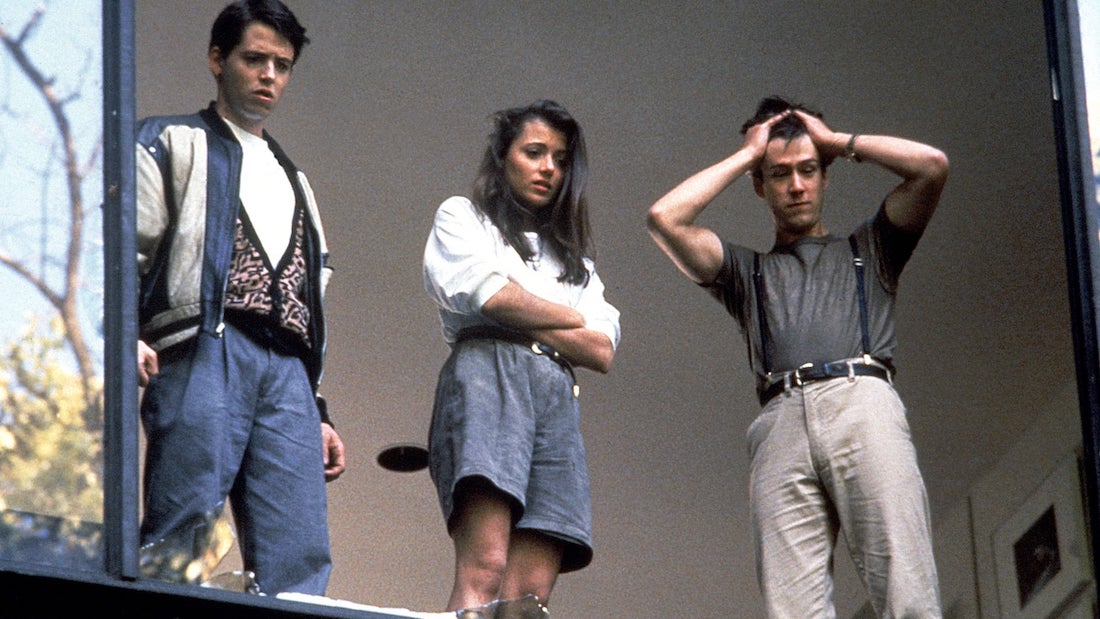
The film follows Ferris Bueller, a privileged high school senior who skips school by faking sickness. He employs his best friend, Cameron, and girlfriend, Sloane, to join his adventure, all the while avoiding getting caught by his family or the principal. From a first glance, the film doesn’t seem to be much more than joyriding luxury cars and jam-packing a day full of sightseeing and musical assemblages. However, it also holds some existential commentary on identity and growing older in direct address to young adults. As absurd as the entire plot of the story is, it executes this more nuanced message through two of its main characters, Cameron and Jeanie.
Towards the beginning of the story, Cameron is depicted as a weak-hearted character. His complacency and fear of his father lead him to draw boundaries, although tenuous ones, with Ferris. For example, in a complicated scheme to pick up Sloane from school without being caught by the principal, Ferris begs Cameron to allow him to drive his father’s Porsche. However, citing how much his father idolizes the car, Cameron resists. His futile efforts to follow his father’s wishes end with the car’s demise.
This incident marks a significant shift in Cameron’s character. Throughout the entire story, he tries to protect his father’s car and prevent his friends from getting in trouble. He not only values his father’s prized car more than his friends, he feels responsible for everything that happens. He is enclosed within the expectations his father sets for him, causing his mental and physical distress. When he accidentally sends the car flying off into his backyard, he loses all of that responsibility. This point for him is the rock bottom–he has let down everyone he cares about and he must face an internal conflict.
In this moment, he had to make a choice: he could be consumed by his overwhelming sense of duty and fall into an irreversible state of regret or he could re-examine his values. Luckily, the story follows the latter path. Cameron realizes that the responsibility he had felt was not for him to bear but for his father, who adored the car more than his own son. He decides to face his father not out of fear for his mistakes but of conviction for his choices. Within the span of one day, Cameron matures into a confident and self-assured individual.
Similarly, Jeanie, Ferris’s older sister, faces the obstacles of expectation and jealousy. Compared to Ferris, she is constantly misjudged and seen as off-putting because of her unfiltered disposition. Jeanie always tries to be perfect and impress others, causing her to draw boundaries with herself. Because of this, she has a rocky relationship with her brother, Ferris, who is able to manipulate situations to his advantage and consistently get away from trouble. Jeanie’s anger reaches its limit when her legitimate fear of the intruder in her house is dismissed by the authorities and her parents. This is the point in which she must confront the boundaries she has set with herself.
In a conversation at the local jail where she shares her frustrations with a boy convicted for drug abuse, Jeanie is faced with the reality that her anger is not directed towards her brother’s antics but her own inability to act the way she wants to. Sometime during that conversation, Jeanie realizes that she doesn’t need to constrain herself to seem perfect. She chooses not only to help her brother avoid getting caught by their parents, but to carve her own path, however nonconforming it is.
What both of these characters share is their foil to Ferris, the loved and idolized popular student. They are placed in uncomfortable contexts and made to navigate their surroundings to eventually find themselves. In this way, we see Ferris as a supporting character, despite narrating the whole story. He not only encourages their development but instigates it, all while having no character development himself.
All this is to say that despite the fact that the main plot of the story doesn’t have a central moral lesson, the story incorporates pockets of struggle and self-search to show viewers that we grow up through experiences, good or bad. Ferris Bueller’s Day Off leads us through the lives of high school students amidst self-discovery in an attempt to show young viewers, facing the daunting realities of post-high school life, the value of growing up and discovering oneself.