She’s The First is a Keynote series in which I interview different women in the Keystone community, whether they be faculty, staff, or parents, to learn more about their lives, careers, and how they empower those around them. It is an initiative with Keystone’s chapter of She’s The First through the Keystone Matters Council. The international nonprofit organization aims to empower, educate, and uplift girls everywhere. If you are interested in She’s The First, you can follow us on Instagram at @stfkeystoneschool.
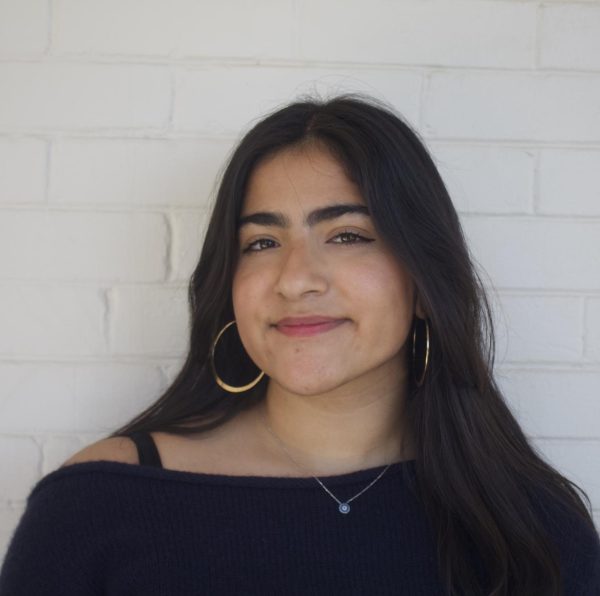
For the October Edition of the Keynote, there was no better way to kick off the first installment of the new school year than interviewing a new teacher in our Keystone community: AP World History and Political Science teacher Noha Pittman. Mrs. Pittman is a NYU and Royal Holloway Alum who joined Keystone this year. Her passion for education and the people around her shines through her teaching and relationships with Keystone students.
This interview has been edited for clarity.
To start, I’d love to learn a little more about your childhood and background. Where did you grow up? What did you do after high school and college? How did you end up at Keystone?
I grew up as a third culture kid and spent most of my childhood bouncing around the Middle East. My parents were living in Kuwait when I was born, but once the war happened we evacuated – I remember learning how to use a gas mask in preschool. I went to middle school in Doha, Qatar, and high school in Dubai. For college, I decided to go to the US and attended New York University (NYU), and studied abroad in Florence during my freshman year. I ended up graduating in 3 years and moved to Bosnia before graduate school, which is where my parents were living at the time. I went to Royal Holloway in the UK for grad school and finished in a year. Then, I moved back to the US, to Panama City Beach, Florida to live with my now-husband. The only job I could get there was teaching at a male correctional facility, so I was 22 years old teaching in a prison, but that experience made me realize how much I liked teaching. I then moved to Washington D.C. around the 2008 recession, but no one was hiring teachers, so I moved to San Antonio because Texas was hiring a ton of teachers. I started out at Thomas Edison High School and eventually moved to Young Women’s Leadership Academy. I moved to Germany a little while later and taught there, which I loved, but then I moved back to San Antonio and taught at Lee High School for a few years. In the middle of the COVID-19 Pandemic, I moved to Singapore and spent 5 years teaching at an American international school. I came back to San Antonio this past year, but didn’t want to teach at a public school given the current socioeconomic and political situation of things, and I applied to teach at Keystone, got the job, and the rest is history.
You’ve had a really expansive learning experience and learned from travelling all over the world. How do you think your education has prepared and shaped you as a person today?
Because I didn’t grow up in a testing era or a public school environment, my education growing up was really amazing. I had great teachers who truly loved what they did, and education was more about content, skills, and applicability than anything else. Living overseas, experiencing a lot of different cultures, seeing different ways of looking at worldwide issues was so important to me. Digesting everything on a global scale made my education a lot more tangible and real. I was naive in the aspect that I thought everyone was getting that kind of education, so when I moved back to the US, and especially when I was working at the correctional facility, I learned otherwise. Teaching elementary and middle school knowledge to grown men, spanning from ages 18 to 65, teaching them things like how to do basic addition and multiplication, and teaching them how to read, was shocking in the way of how the public school system had massively failed them and so many economic disadvantages had gotten in the way of their education. It was extremely eye-opening. The public school system in San Antonio was also very shocking. There were so many students that were not anywhere near reading at grade level, and trying to make things like the Song Dynasty in China matter to them in their current environments and situations was very hard, but taught me so much.
I feel like experiencing those situations so young, especially teaching in the correctional facility, must have been really mentally taxing. If you could give yourself any advice during that crucial, identity-forming time in your life, what would you say?
I would tell myself to breathe. Just breathe. Patience is not one of my virtues, and when I first started teaching, I really thought I had everything in my favor and was going to start making a difference on day one. I was so stressed out and panicked when I didn’t see any immediate improvement when, in reality, I wasn’t taking time to watch the little changes. I had to realize that getting them to think outside of their neighborhood, think about college for the first time ever, think about why something matters, had a much bigger impact. I still keep in touch with a lot of those kids, and they make me really proud of myself and them.
That’s so important and necessary to realize. If you could give advice to young women at this age, or going through similar experiences, what advice would you give them?
No is a complete sentence. You don’t owe anything, any explanation, to anyone, and once you start thinking that way, things shift in your mind. Once you stop feeling like you owe the world something for the things that you are doing or want to do, you tend to start doing them, and stop doubting yourself in the process. Justifications to others never measure up. What you want is what matters.
How did you choose (teaching) as a profession, and what inspires you to continue to pursue it each day?
I never actually planned on being a teacher. I wanted to be the next Christiane Amanpour, and report in conflict zones and areas. But, when I moved to Italy my freshman year of college, I fell in love with medieval history and realized I wanted to do something with that. My favorite museum in the entire world is the Uffizi Gallery in Florence, and a part of me thought about how much I would have loved to be the curator of that museum. I really wanted my job to be surrounding academics, and pursuing history became a way for me to do that. After I finished graduate school, working at the correctional facility was the only job I could find in Panama City Beach, and it led me to try teaching. It wasn’t even close to teaching history, but it made me feel like I was accomplishing something, and making something happen for someone else. I view teaching as playing a role in changing the course of someone’s life, and working at the prison taught me that I could do that. I also love how teaching is different everyday, and how even though I’m teaching the same things each day, every kid is unique, and seeing them interact with each other and debate and change perspectives is really amazing.
Who is your biggest female role model, and why?
I have several for different reasons, but the first one that comes to mind is Mary Shelley, first because of how young she was when she wrote Frankenstein, and second, because when she married Percy Shelley, she never let the fact that she was married to someone who was equally as significant as her dim her own light, and how cool it is that she could be with someone else and still explore her own brilliance. Contemporarily, I love Michelle Obama, and even more historically I love Hatshepsut, the only female pharaoh of Cairo.
To conclude our interview, I’d like to end with some rapid-fire questions.
Last book you read? Samantha Power’s The Education of an Idealist.
Superpower you wish you had? To teleport, because I’m a big traveller.
Go-to dessert? Fresh baked chocolate chip cookies.
If you could live anywhere else in the world, where would it be? Florence, Italy.
If you weren’t a teacher, what profession would you choose? Journalism.